The word "smart" has been stretched thin
Walk through the wine world today and you'll find the word "smart" attached to almost everything — an app that catalogues your bottles, a cooler with a Wi-Fi chip, a cabinet with a touchscreen. Each does something useful. But most of them are smart in only one dimension, and that limitation is precisely what keeps a collection from feeling effortless.
A wine collection lives in two places at once. There is the physical collection — the bottles themselves, resting in a space, governed by light, temperature, and time. And there is the virtual collection — everything you know about those bottles: what they are, what they cost, when they'll be ready, what you thought the last time you opened one. For most collectors these two worlds never quite meet. The bottles sit in one room; the knowledge sits in an app, a spreadsheet, or memory. Bridging the gap is left to you.
A truly smart cellar closes that gap. It is one where the virtual and the physical are a single, integrated system — where what you know about a bottle and where that bottle physically sits are the same experience, not two chores you reconcile by hand. Everything below is a measure of how close a given approach gets to that ideal.
Option one: pure virtual — the inventory apps
The most common entry point is software alone. A number of apps compete in this space: CellarTracker, InVintory, Enolisa, and Sommo all let you build a digital record of your collection, with varying depth of community data, valuations, and tasting notes. Vivino sits at the top of this category: its global community, label-scanning technology, and discovery tools go well beyond simple cataloguing, making it the most complete virtual wine experience available.
These tools are genuinely valuable, and for many collectors they're the right first step. They bring order to chaos and they're inexpensive. Credit where it's due: a well-kept CellarTracker list is far better than no system at all.
But it's worth being clear about what they are. They are catalogues of the virtual collection, with no connection to the physical one. The app knows you own a 2015 Barolo; it has no idea where in the room it is, and no way to help you find it among two hundred others. Worse, the record is only as current as your discipline. Every bottle in, every bottle out, every gift and every dinner has to be entered by hand. Miss a few and the catalogue quietly drifts away from reality — which, for the collections these apps are meant to serve, tends to happen sooner rather than later. The intelligence is real, but it stops at the screen.
Option two: the pseudo-physical bridge — digital twins, barcodes, and tags
Recognising that gap, a second class of products tries to reconnect the virtual record to the physical bottles. These are the options available today for physically tracking bottles rather than merely listing them, and they are a step forward in ambition — the instinct behind them is right. The execution, though, tends to reintroduce friction by a different door. (We compare all four approaches in detail in our guide to physical wine cellar inventory management.)
3D models and digital twins. Some systems build a virtual replica of your cellar — a 3D map where you place each bottle in its corresponding slot on screen. In principle, you can then "see" where everything sits. In practice, the model is only ever as accurate as the last time someone updated it. Move a bottle and the twin is wrong until you tell it otherwise. You end up maintaining two cellars — the real one and its digital shadow — and keeping them in sync becomes its own small job. The promise is integration; the reality is duplication.
Barcodes, QR codes, and RFID tags. Others attach a code or a tag to every bottle, so you can scan wine in and out or wave a reader to take inventory — the most common form of a physical wine bottle tracking system. The underlying technology is capable, and for commercial logistics it genuinely shines. In a personal collection, though, it asks something of you every time: a label or tag applied to each bottle (not always welcome on a treasured one), a scanner to reach for, a step to remember at exactly the moment you'd rather just enjoy the wine. It connects the two worlds, but it taxes the owner for the privilege. Intelligence should remove steps, not add them.
The common thread is that the burden of integration still falls on you. The system can only reflect the physical collection if you keep feeding it — and the moment life intervenes, the connection breaks.
Option three: the standalone cabinet
A third approach builds the technology into a self-contained, enclosed wine cabinet — a finished appliance with cooling, sometimes a screen, occasionally bottle tracking, all in one box you place in a room.
For certain situations these are a sensible choice. In an apartment, a secondary residence, or a space where built-in work isn't possible, a quality standalone cabinet from a maker like EuroCave or Liebherr does its job well. There's no criticism in choosing the right tool for a constraint.
But a cabinet is a piece of equipment placed in a room, not architecture that belongs to it. However handsome, it arrives as a fixed object in someone else's dimensions and finishes — and in a considered interior, it tends to read as exactly that. It sits against the wall rather than becoming part of it. It doesn't pick up the stone, the timber, the proportions of the space around it. It looks added, not intended. And because it's a sealed box, it can't do what a true architectural cellar does for a room: shape the light, set a mood, become the quiet centrepiece people are drawn to. You get storage and perhaps some intelligence, but not presence. For a collection meant to be lived with and shown, that absence is felt.
What integration actually looks like — and why we built Uva
Each of these approaches gets one part right. The apps understand the virtual collection. The tag-based systems try to touch the physical one. The cabinets at least put the wine in the room. What none of them does is unite all of it — knowledge, bottle, and space — into something that feels like one intentional whole. That gap is the reason Uva exists.
A Uva cellar is designed as architecture first. Integrated Design means the cellar is built into your space and finished to match it — the same materials, the same proportions, the same intent as the room it lives in. It doesn't sit against the wall; it becomes the wall — the result of a great deal of engineering built to disappear. And because it's designed rather than dropped in, light becomes part of the experience: distributed, tunable illumination that reveals the collection beautifully and colours the ambiance of the room, without exposing the wine to harm. (Climate is handled with the same care — stable temperature and humidity, continuously monitored — but in a Uva cellar that protection is the quiet baseline, not the headline.)
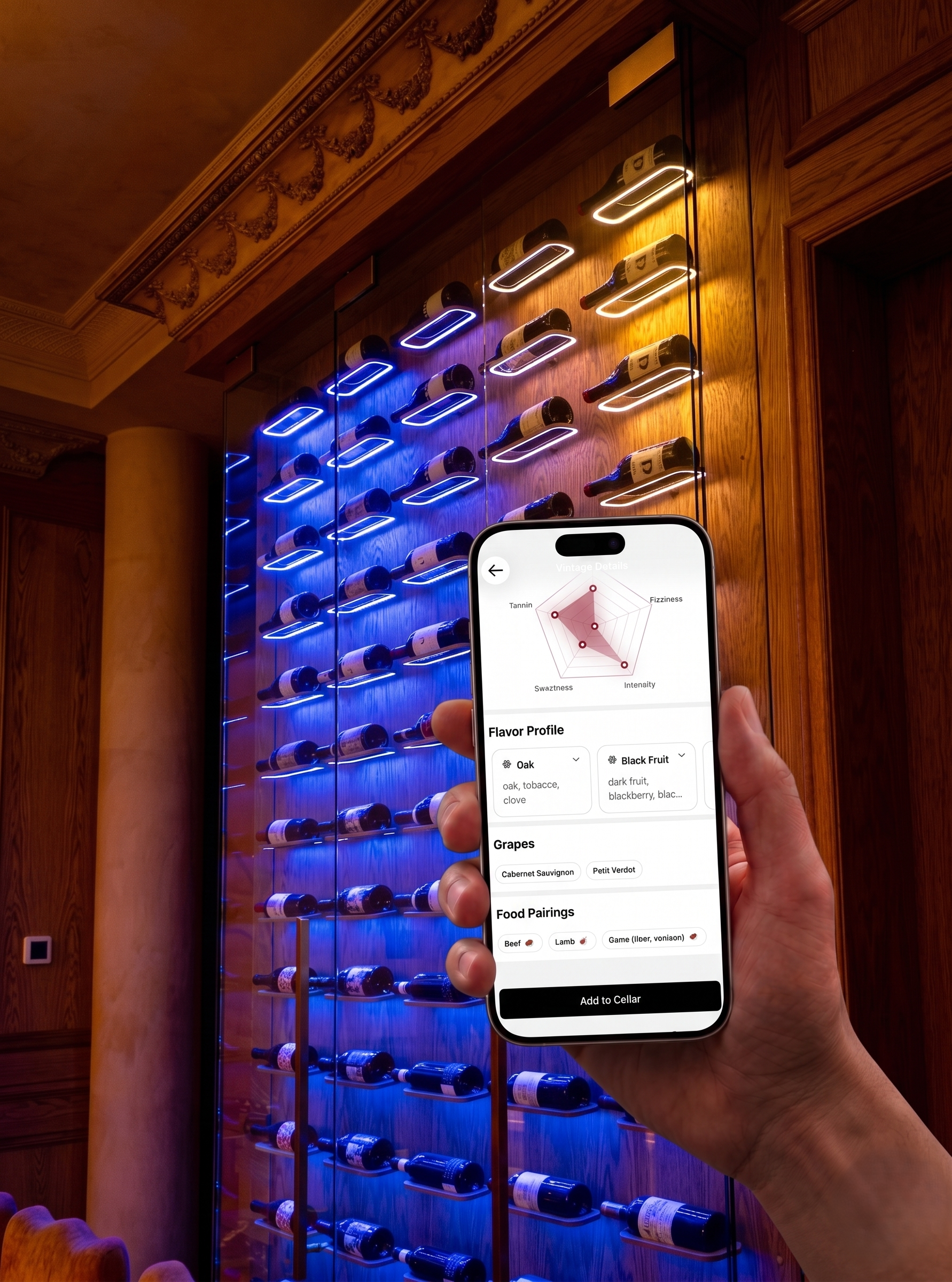
The deeper difference is that the physical and virtual collections are the same system. The cellar knows what's in it and where each bottle sits, without you maintaining a separate digital twin or scanning a tag each time. Inventory Management gives you full, always-current visibility of what you own, and the Virtual Catalogue turns that into a curated digital experience of every bottle — the knowledge and the wine, finally in one place.
That knowledge layer is powered by Vivino. Through our partnership, every bottle in a Uva cellar is enriched with Vivino's world-class wine database: producer details, vintage notes, community ratings, and drinking windows drawn from millions of data points. It is the deepest wine intelligence available, brought directly into the physical space where your collection lives.
And then the cellar starts to give something back. Our Smart Sommelier™ learns your collection and guides you through it — surfacing what's entering its ideal window, suggesting what suits the evening, quietly building your confidence. Alongside it, Palate IQ™ learns you — your tastes, your reactions, the wines that have moved you — so the guidance grows more personal over time. Together they do something no catalogue can: they help you learn about wine using your very own collection, turning every bottle you already own into a way to understand your palate better. Like art, wine can be enjoyed intuitively — but the pleasure deepens when expertise is brought right up against the experience. That is the whole point of a smart cellar. Not more to manage. More to enjoy.
So, what makes a cellar truly smart?
It isn't a chip in a cooler or a tidy app. It's the seamless union of the collection you own and everything you know about it, set inside a space designed to make both beautiful. The apps, the digital twins, the tags, the cabinets each reach for a piece of that. A genuinely smart cellar holds all of it at once — and asks nothing of you but the pleasure of choosing the next bottle.
That is what we mean when we say we give your collection more meaning.