The problem nobody designs for
A collection is meant to be seen. The pleasure of a cellar is partly in looking at it — the labels, the depth, the quiet sense of everything you've gathered in one place. And yet the very thing that lets you see it, light, is one of the forces working against the wine inside.
Light, and the heat that usually travels with it, gradually ages wine. The phenomenon even has a name among winemakers: light strike. Short wavelengths — blue and ultraviolet — carry the most energy and do the most damage, dulling a wine long before its time. For most cellars this leaves an awkward compromise: keep it dark and lose the beauty, or light it well and quietly pay for it.
We didn't want to accept that trade-off. So we engineered our way out of it.
Light only where you're looking
Most lit cellars work the way a room does — fixtures concentrated at the top or bottom, throwing light across everything at once. To reach the far bottles, that light has to be intense, which means the bottles nearest the fixtures are constantly over-exposed.
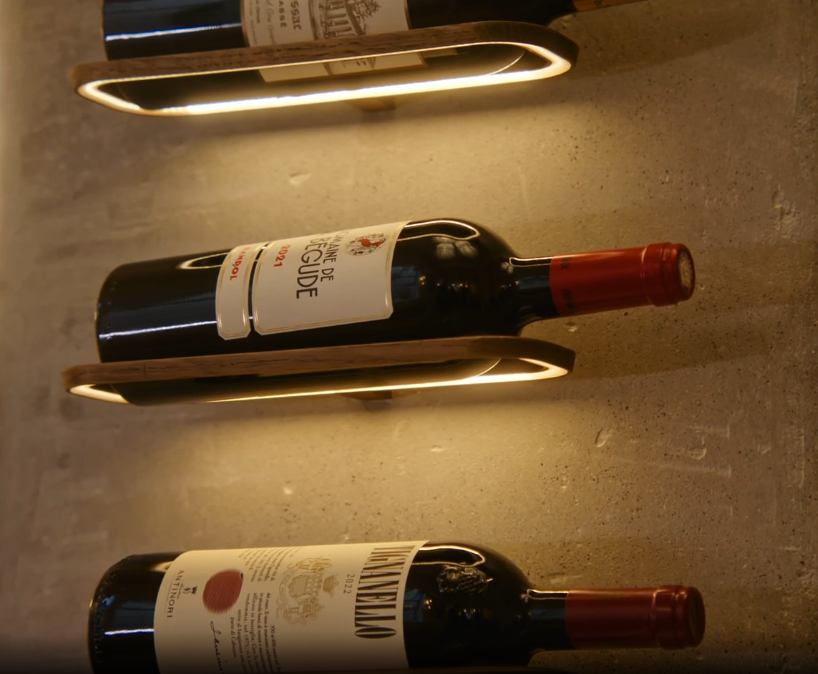
The Uva Smart Wine Cellar takes the opposite approach. Every bottle has its own individually addressable light source, distributed across the entire cellar. Because the light is spread out rather than concentrated, each emitter can run at a fraction of the intensity and still illuminate beautifully — lowering both peak and average exposure across the whole collection.
Better still, light appears only where you need it. Select a bottle and that bottle lights up; the rest of the cellar stays at a low, ambient glow. You get perfect visibility on the wine you're choosing without bathing the entire collection in light it doesn't need.
Tuning the colour of light itself
Not all light is equally hard on wine. The blue end of the spectrum carries the energy associated with light strike, so we built our system to keep that content low from the start.
Alongside separately controlled colour channels, every light source includes a dedicated warm-white channel at 2,700K — so even full white illumination stays low in blue. For especially sensitive collections, an optional Redshift mode biases the output further toward longer, gentler wavelengths, suppressing blue and its associated risk even more. The LEDs themselves emit very little UV to begin with; reducing blue takes the short-wavelength energy lower still.
Numbers, for the people who want them
Restraint is easy to claim and harder to prove, so here are the figures.
Wine specialists generally treat under 25 lux as safe for long-term storage, up to about 50 lux for an hour a day, and up to roughly 200 lux for a few minutes at a time. The Uva cellar lives comfortably inside those bands. Day to day, ambient lighting sits at 10 lux or less. A temporary spotlight for finding a bottle stays under 80 lux, and only for a moment. Even at maximum brightness — a setting that would almost never be used in practice — the cellar tops out at 120 lux.
And for your most treasured bottles, the system does something no conventional cellar can: it tracks cumulative exposure, bottle by bottle. The cellar knows how much light each bottle has received over time, measured in lux-hours. Set a daily exposure budget for a prized or particularly vulnerable bottle, and if it nears that limit, the system dims it automatically. Protection without a single manual intervention.
Keeping heat away from the wine
Light is only half the story; heat is the other. LEDs already convert far more of their power into light, and far less into heat, than the incandescent or halogen sources older cellars rely on — so there's less thermal load where it matters.
We went further and moved the heat-generating electronics — the drivers and controllers — into the cradle stem behind the wall, away from the bottles and with little path to conduct warmth toward them. The result isn't a claim, it's a measurement: thermal testing showed negligible temperature rise at the bottle surface and minimal heat reaching the wine, even during brief moments at full brightness.
What this means for your collection
You don't have to choose between a cellar you can see and a cellar that protects what's inside it. With distributed, targeted lighting, your overall exposure stays well below typical integrated systems. With spectrum control and Redshift mode, the light itself is gentler. With per-bottle UV budgets, your rarest wines look after themselves. And with the heat engineered away from the bottles, the wine simply rests as it should.
This is what we mean when we say design and technology belong together. The cellar is more beautiful because of how carefully it's been engineered — not in spite of it. It's one part of a larger idea: what makes a wine cellar truly smart. That's the whole idea behind Uva: we give your collection more meaning, down to the wavelength of the light that touches it.
We give your collection more meaning — down to the wavelength of the light that touches it.