The best engineering is the kind you never see
There is a particular kind of luxury that announces itself — gloss, weight, visible mechanism. And there is a rarer kind that does the opposite: it removes everything that would remind you it's there, until all that's left is the experience itself. A bottle glides into place. The wall glows. The right wine is simply there when you reach for it. Nothing whirs, nothing blinks for attention, nothing asks to be operated.
That calm is not the absence of technology. It is the result of an enormous amount of it, arranged so carefully that it vanishes. Everything described below was built so you would never have to think about any of it. We think it's worth showing you once — because understanding the craft is part of what makes a collection feel meaningful.
The cradle, and the wall that holds it
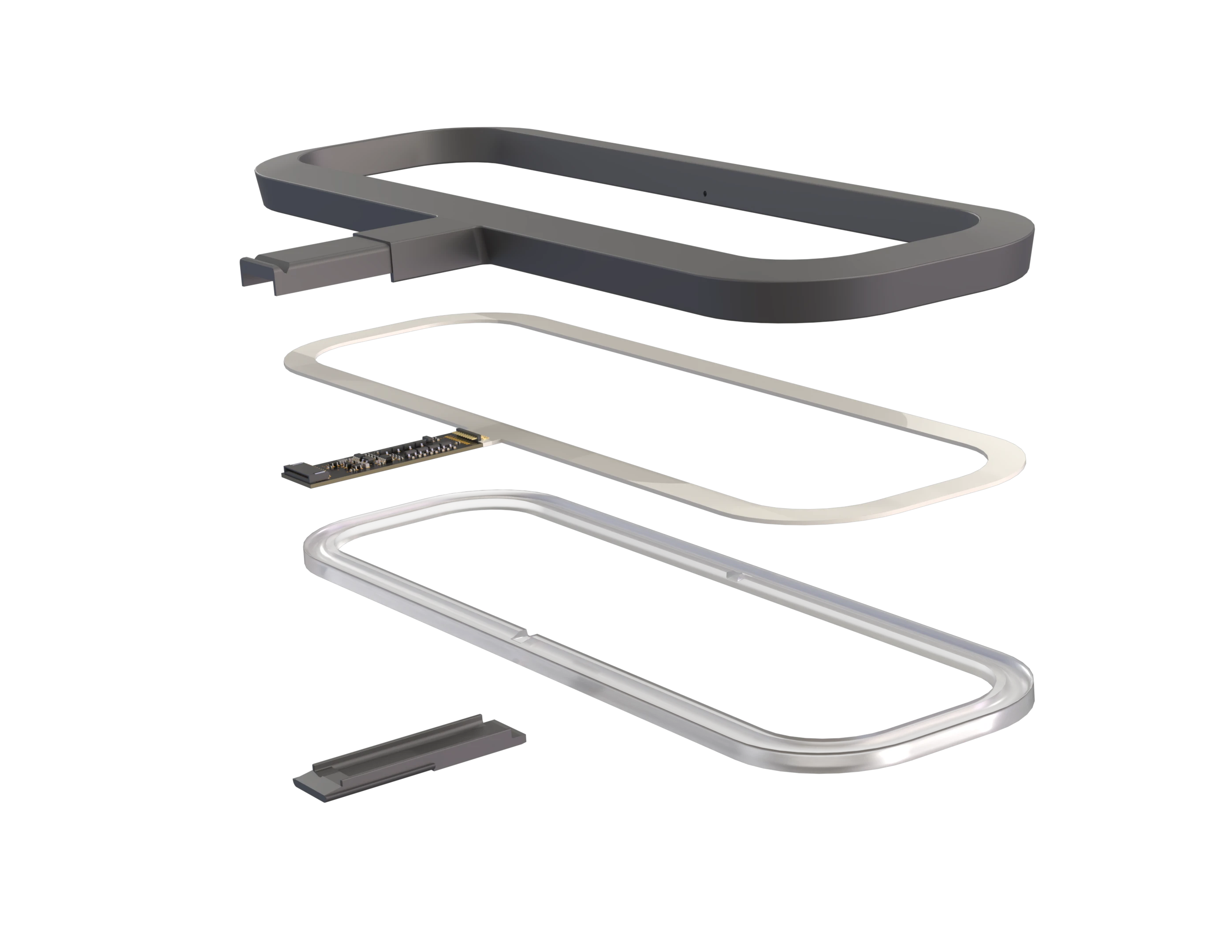
Start with the single most important object in the system: the cradle. Each bottle rests in its own cradle, and behind every cradle, hidden in the wall, is a magnetic latching receptacle. Present a cradle to the wall and it snaps home — held securely by magnetic latching, with no brackets, no screws, no visible fasteners anywhere on the face of the wall. In the same motion, the cradle establishes both its electrical connection and its data connection. One clean gesture, and the cradle is powered, communicating, and locked in place.
This is more than an elegant trick. It's the decision that shapes everything else. Because the connection is made at the back, all of the sensitive electronics live on the cradle itself, not buried inside the wall. That choice has a quiet but profound consequence for you as an owner: there is nothing to cut into.
We engineer cradles with high-quality components and hold them to exacting reliability standards — the goal is a cradle you never think about for the life of the cellar. But should a component ever need attention, which is rare, the repair is refreshingly undramatic. The cradle releases from the wall, and a replacement snaps in. No opening walls, no dust, no contractors, no reconstruction of a finished room. Repair is fast, and cellar downtime is kept to a minimum. The architecture stays intact because the architecture was never where the electronics were.
Light, made thin enough to hide
A minimalist cellar lives or dies on its lighting. Light is what gives the wall its presence, yet the hardware that produces it is exactly the sort of thing that ruins a clean line. So the lighting had to do something difficult: be powerful and beautiful, and nearly invisible.
The answer was density. Each cradle carries dense COB (chip-on-board) lighting — more than 600 LEDs packed into a remarkably thin profile. Concentrating that many emitters so tightly lets us keep the physical depth minimal and the light diffusion tight and controlled, which is precisely what preserves the spare, intentional aesthetic we set out to achieve. There's no bulky housing, no glow bleeding where it isn't wanted — just light where we placed it, exactly as much as we placed.
Driving that light cleanly is its own discipline. Each cradle runs on eight precisely tuned constant-current drivers — eight, per cradle — which is what delivers the exceptional uniformity and fine control the system is known for. Constant-current drive keeps brightness and colour steady and even, with none of the flicker or unevenness that betrays cheaper lighting. It's the difference between light that looks engineered and light that looks effortless.
Two kinds of light, on purpose
We didn't want a cellar that was simply "lit." We wanted light that could do two jobs at once, so each cradle's light ring is intentionally split into two independently addressable segments.
A back segment faces the wall — the mood light. It washes the wall and columns behind the bottles with soft, diffuse light, painting the architecture and setting the ambiance of the entire room. This is the light that makes the cellar feel alive when you walk past it.
A spotlight segment faces forward, throwing more focused light onto the bottle itself. This is the light that steps in when you're searching for a wine or want to draw the eye to a particular bottle — a single vintage lifted out of the field, quietly emphasised.
Because the two are controlled independently, the cellar can hold a calm, even glow across the whole wall while picking out exactly the bottle you're looking for. Ambiance and function, in the same surface, never fighting each other.
Wiring that earns its place
None of this is worth much if the space behind the wall is a tangle. Clean architecture in front demands clean engineering behind, so the unseen layer got the same attention as the visible one.
Cradles are connected with custom flexible printed-circuit (FPC) cabling — tidy, efficient, and dramatically neater than conventional wiring looms. Power and data are handled by custom delivery modules built specifically for this system rather than adapted from off-the-shelf parts. And the whole assembly is presented through infinitely customisable integrated bulkheads: for the top row, Uva cradle components are recessed inside the bulkhead, so the hardware sits flush and the result reads as a deliberate architectural feature — a clean line that blends with the room's millwork and finishes rather than interrupting them. The cellar looks built-in because it is built-in, down to the last conductor.
A sensor network that refuses to make you wait
Here is a belief that drove some of the hardest engineering in the system: you should never feel like you are interacting with technology. The moment there's lag — a beat between your action and the cellar's response — the spell breaks, and no amount of polish reads as luxury after that.
Delivering that immediacy is harder than it sounds. The cellar uses an infrared sensor array to know the state of every cradle, and it has to read up to thousands of cradles, hundreds of times per second, without a flicker of delay. Conventional addressable buses simply couldn't do that cleanly — the per-message overhead and the conductor count both worked against us.
So we built our own. We developed a proprietary addressless serial bus, purpose-made for this one job. Stripping out addressing overhead lets the system poll the entire array at the speed responsiveness demands, while keeping the conductor count very low. That low conductor count matters on three fronts at once: it keeps the install wiring clean, it keeps cost in check, and — most importantly — fewer conductors mean fewer points of failure, so the whole system is simpler to install and more reliable for years afterward. It's a bus you'll never hear about because it does its job perfectly: the cellar just knows, instantly.
Lighting on its own channel, because art can't stutter
The lighting deliberately runs on a completely separate communication protocol from the sensor bus. That separation is intentional, and it matters. This cellar doesn't just illuminate a collection — it doubles as a piece of interactive lighting art, and art can't stutter. Effects need to be vibrant, transitions need to be smooth, animations need to glide.
Giving lighting its own dedicated channel means it never competes with sensing for bandwidth. The sensor bus stays singularly focused on knowing where every bottle is, while the lighting protocol is free to deliver rich, fluid, responsive motion across hundreds of LEDs per cradle. Two demanding jobs, each on a network built for it, neither compromising the other.
Fighting for fractions of a millimetre
All of this — the latching mechanism, six hundred-plus LEDs, eight drivers, the connectors, the custom cabling — had to fit inside a cradle slim enough to honour a minimalist aesthetic, and strong enough to cradle a full bottle of wine safely and to survive years of daily handling and wear.
Those goals pull against each other constantly. Every component we added wanted depth; the design wanted none. Every gram of electronics had to coexist with the structural strength required to hold real weight without flex or fatigue. There was no slack anywhere in the envelope, so we fought for every fraction of a millimetre — packaging, re-packaging, and tuning the mechanical design until the cradle could be beautiful, dense with technology, and genuinely robust all at once. The restraint you see on the surface is the visible edge of a very deliberate fight underneath it.
Why we sweat the parts you'll never see
It would be easier to do less of this. A bigger housing, a standard bus, electronics in the wall, a visible fastener here and there — each shortcut would save real effort, and most people would never name what was missing. But they would feel it. The lag, the bulk, the cabinet that sticks out, the repair that means opening a wall: those are the small frictions that quietly tell you you're using a machine.
We removed them on purpose, one by one, so that what remains is just you and your collection. That is the whole intention behind Uva — and it's the same conviction behind what makes a wine cellar truly smart. The engineering disappears so the wine — and the pleasure of living with it — can take the room.
We give your collection more meaning — right down to the millimetre you'll never see.