A collection deserves a space designed around it
Most wine cellars begin as an afterthought — a corner of a basement, a converted closet, a cooler that fills up faster than expected. They hold the wine, but they don't do it justice, and they rarely make the collection any easier to enjoy.
A custom modern cellar starts from the opposite premise: that the space should be designed around the collection, around the life happening near it, and around how you actually want to engage with what you own. Done well, it does three things at once. It protects the wine properly, it makes the collection effortless to engage with — increasingly with the help of intelligent technology — and it becomes something beautiful in its own right: a contemporary centrepiece that still feels right twenty years from now.
That last point is the whole challenge of a modern cellar, and it's where most go wrong. This guide walks through how it comes together, in the order the decisions actually arrive, with particular attention to the thing modern cellars get wrong most often — integrating technology without dating the space.
It also helps to know early who designs a cellar like this. The work usually involves several people — an architect or interior designer, a builder, and a cellar specialist who understands how wine is stored and shown. The smoothest projects are the ones where those roles are coordinated from the start. Uva can work alongside the architect, designer, or home builder you already have, or take on the design itself; the section on working through every stage below covers how that collaboration tends to work.
Start with how you'll use it, not how it looks
The most useful first question isn't "what should it look like" — it's "how do I want to live with my wine." The answer shapes everything downstream.
A collector who buys to drink wants easy access, clear sightlines, and guidance on what's ready. A collector who buys to age and hold wants capacity, stability, and room to grow. Someone who entertains often wants the cellar to be visible and part of the experience; someone who values quiet wants it considered and private. There are no wrong answers, but being honest about your habits early prevents the most common regret — a cellar that's beautiful but doesn't fit the way you actually use it.
Be honest, too, about how the collection will change. Most grow faster than their owners expect. Planning for where you'll be in five years, not just where you are today, is the difference between a cellar you settle into and one you outgrow.
New build or existing space — both can be done beautifully
There's a persistent myth that a custom cellar only works if you're building from scratch. It's not true, and it's worth dispelling early, because it stops people from doing something genuinely achievable.
A cellar planned alongside a new build integrates into the architecture from day one, which is wonderful when the timing allows. But an existing room — a basement, a study, a dining-room wall, an under-stair space — can become an exceptional cellar too. The reason retrofits sometimes earn a bad reputation isn't the idea; it's the execution. A retrofit done poorly looks exactly like what it is: equipment added to a room that wasn't expecting it, sitting awkwardly against finishes it doesn't share, reading as an afterthought.
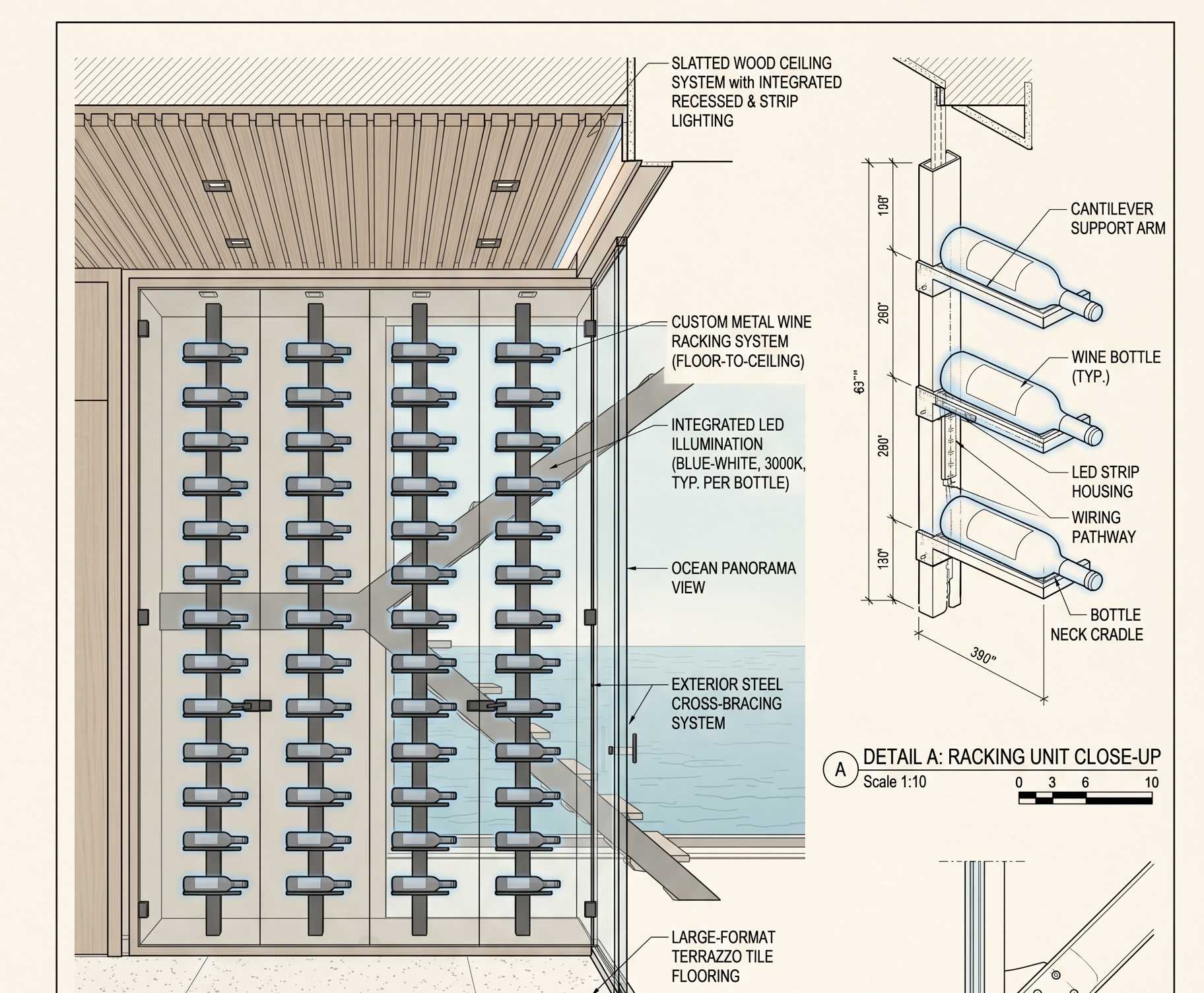
A retrofit done well looks like it was always meant to be there. The difference comes down to the system you build with. A rigid, one-size approach forces the room to accommodate the product. A flexible, modular system does the opposite — it adapts to the room's real dimensions, columns, and quirks, so the cellar fits the space rather than fighting it, without surrendering the bespoke character a luxury cellar demands. This is precisely the problem we designed our racking system to solve: modular and adaptable enough to retrofit an existing space cleanly, bespoke enough that the result never feels off-the-shelf.
Insist on a system flexible enough to be tailored to your space. With the right one, a retrofit can be every bit as considered as a ground-up build.
The modern question: technology that doesn't age
Here is where modern cellars succeed or fail. The appeal of a contemporary cellar is partly the technology — inventory you can actually see, guidance on what to drink, lighting that brings the space alive. Used well, it transforms how you engage with a collection. Used carelessly, it's the fastest way to date a room.
It's worth being clear-eyed about this: technology, historically, does not age gracefully. Screens, glossy panels, exposed gadgetry, and of-the-moment styling look current for a few years and conspicuously old soon after. A cellar is a long-term space — it should outlive several generations of consumer electronics. So the goal isn't more technology on display. It's technology that earns its place and then disappears.
That principle shaped how we built our own system, and it's the standard we'd urge anyone to hold a modern cellar to. The structure and the surfaces should be timeless, organic materials — the wood, stone, and metal language that has looked right for a century and will look right for the next. The intelligence should be present everywhere and visible almost nowhere: the sensing, the connections, the electronics tucked out of sight, so what you see is the wine and the craft, not the circuitry. A modern cellar should feel modern because of how it works — effortless, responsive, intelligent — not because of how much hardware it shows off. We've written more on this idea in engineered to disappear.
The environment: protecting what's inside
This is the non-negotiable layer, the part that has to be right regardless of style. Wine ages well only in stable conditions: a steady temperature, relative humidity in a comfortable band, protection from vibration, and shelter from light — especially UV. The single most important word is stable; swings do more harm than a constant temperature slightly off the ideal.
The targets most specialists hold to: a stable temperature of 12–14°C (about 55°F), relative humidity around 60–70%, low vibration, and minimal exposure to light — especially UV. Stability matters more than hitting an exact number.
What matters at the design stage is planning for it properly — insulation, a vapour barrier, and a cooling approach suited to the room — rather than retrofitting around a space that fights you. Get the envelope right and everything else becomes easier.
Capacity, layout, and growth
Capacity sounds like a simple number, but it's really a layout decision. How many bottles, in what mix of formats, displayed how — single bottles facing out, magnums, cases held back — all change the geometry of the space.
Two principles save most people from regret. First, plan for more than you own today; collections grow, and adding capacity later is far harder than building it in now. A modular system helps here too — one that can extend as the collection does. Second, decide what you want to see. Wine stored label-out and individually lit reads completely differently from wine stacked in bulk. A custom design lets you mix display-forward presentation for the bottles you love with efficient storage for the rest.
Light and atmosphere
Lighting is what separates a storage room from a space with presence — and in a modern cellar it's also where technology and timelessness meet most visibly. The same light that makes a collection glow can quietly age it, so the art is delivering beauty and visibility while keeping exposure low and heat away from the bottles.
Thoughtful cellar lighting works on two levels: a soft, ambient wash that gives the space mood and depth, and focused light that lets you find and appreciate individual bottles. When those are controlled independently, a cellar can feel calm and alive at once while still treating the wine gently — and the light fixtures themselves should be as discreet as the rest of the technology, felt rather than seen. We go deeper on this in seeing your collection without exposing it.
Materials, finishes, and integration
A custom cellar should feel like it belongs to the room it lives in, not like an appliance set down inside it. That means choosing materials and finishes that converse with the surrounding architecture — the same timber, stone, metal, and proportion language as the rest of the space — so the cellar reads as intentional rather than added.
This is doubly true for a modern cellar, where the temptation to lead with technology is strongest. The discipline is to let timeless, natural materials carry the look and let the technology serve quietly underneath. That's the heart of what we mean by Integrated Design: the cellar built into the space, finished to match it, with the intelligence woven in invisibly — so it becomes a centrepiece that complements the room and survives the decades, rather than a tech installation that interrupts the room and dates with it.
What drives the cost
Custom work resists a single number, because the cost follows the decisions above. But it's worth understanding the main levers so you can plan with eyes open. Cost is shaped by the size of the space and capacity; the complexity of climate control (an interior basement is easier than a sunlit room with exterior walls); the materials and finishes you choose; the degree of architectural integration; the level of technology and lighting; and whether the cellar is a new build or a retrofit.
The honest framing: a custom modern cellar is an investment in both the longevity of the wine and the experience of living with it — and, done right, in a space that won't need redoing when this decade's styling looks dated. Set a range early, be clear about which elements matter most to you, and design to those priorities rather than maximising every variable at once. A good design partner should help you spend where it counts and restrain where it doesn't — including knowing where not to add technology for its own sake.
Timeline: what to expect
A custom cellar is a project, and projects have rhythm. Broadly, it moves through design and planning (defining use, space, capacity, and aesthetic), then detailed design and specification, then fabrication of the cellar and its components, then installation, and finally the pleasure of stocking it. A modular system can make installation — particularly into an existing space — notably cleaner and faster than bespoke joinery built in place.
Timelines vary with scope and with whether the work is folded into a larger build, so the most useful step is an early conversation that turns your space and goals into a realistic schedule.
Working through every stage — with your team or ours
A cellar of this kind is rarely built by one person. It usually brings together an architect or interior designer, a builder or general contractor, and a cellar specialist who understands how wine is actually stored and shown. The projects that run smoothly are the ones where those roles are aligned from the first sketch, rather than reconciled on site at the end.
Uva is set up to fit into that process at whatever point you need. If you already have an architect, designer, or home builder you trust, we work directly alongside them — sharing specifications, tolerances, and integration details early, so the cellar is designed into the room rather than fitted around it. If you'd rather have it handled end to end, we can provide the design ourselves, from first concept through to a fully specified, installation-ready plan.
We've also partnered with a number of leading design firms whose teams are trained specifically on integrating our system into a wider interior vision. So whether the design comes from us, from your own team, or from one of our partners, the people drawing your space understand how the racking, climate, lighting, and intelligence come together — and the cellar is resolved on paper, not improvised during installation.
We give your collection more meaning — in a space that's contemporary today and still timeless decades from now.