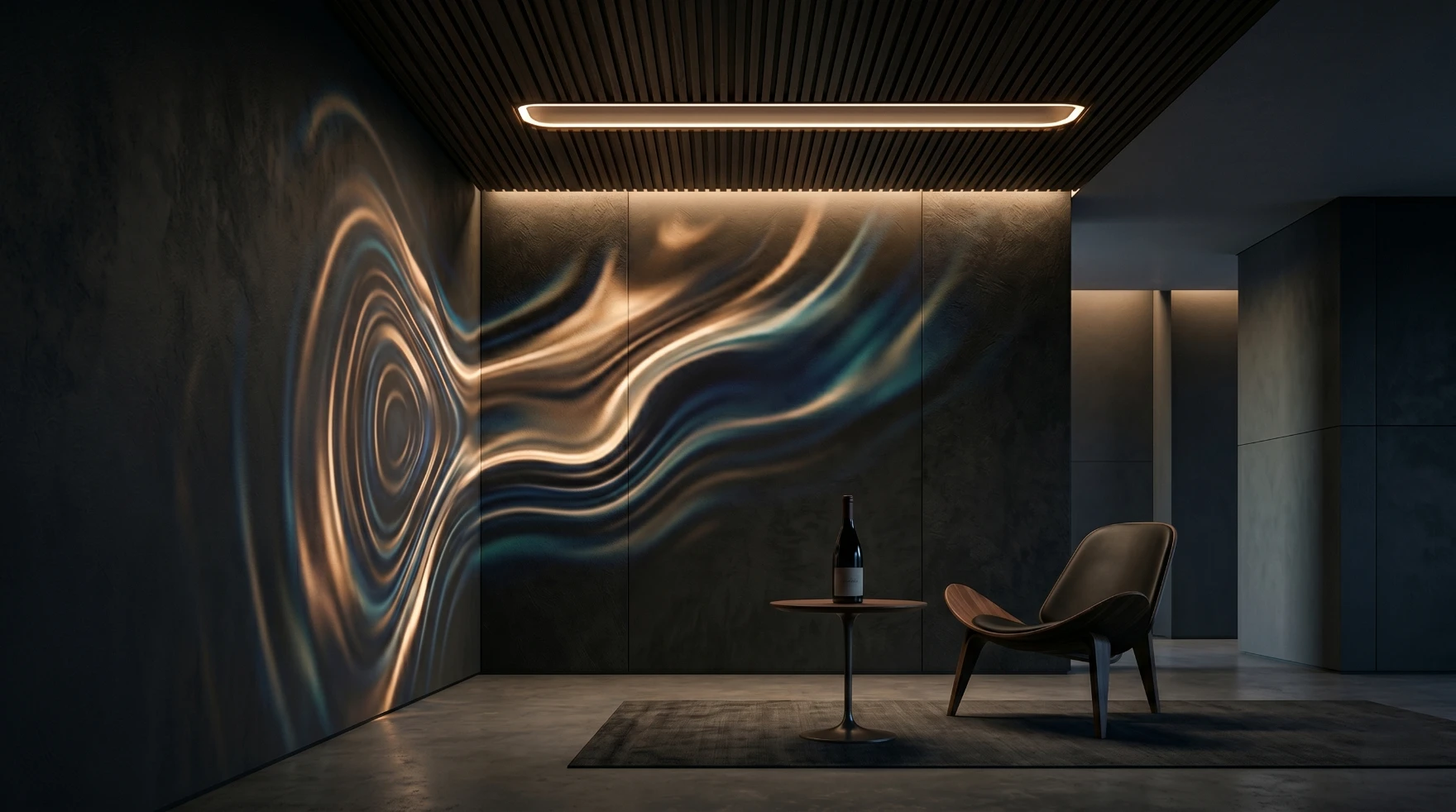
There is a particular moment I look for in every space we design. It is the moment someone walks in, and the room seems to notice. The light lifts to meet them. A wall warms by a few degrees of colour. A shape that was resting begins, almost imperceptibly, to move. Nobody touched a switch. The room simply responded — the way a good host turns toward the door when a guest arrives.
For most of the last century, lighting design was a question of placement and intensity. Where do the fixtures go, how bright, how warm, how hidden. We lit rooms the way you might frame a photograph: carefully, but once. The result was fixed. Beautiful, often, but inert.
That is changing, and quickly. Light has become a living medium — something that senses, adapts, and participates. The most compelling interiors being built today do not treat light as a finish applied at the end. They treat it as a character in the room, with its own behaviour. And once you have experienced a space that responds to you, the ordinary, static room never quite feels finished again.
Light as a material, not a fixture
The first shift is conceptual, and it belongs to the artists before it belongs to us.
For decades, a small number of artists have insisted that light is not a tool for revealing objects but a material in its own right — something you can shape, weigh, and stand inside. James Turrell built an entire career on this idea, making rooms where light is the only object, where the eye loses its bearings and you become aware of the act of seeing itself. There is nothing on the wall. The light is the work.
That sounds abstract until you bring it into a home. The reframe is simple and profound: stop asking what the light reveals, and start asking how the light behaves. A fixture illuminates. A material has presence, texture, and the capacity to change. When you design with light as a material, you are no longer decorating a room — you are giving it a temperament.
This is the foundation everything else rests on. Responsiveness only matters because light has become something we sculpt rather than something we install.
What the gallery taught us
If you want to understand why responsive light moves people so deeply, spend time with the installations that pioneered it. Three in particular changed how designers think.
In 2003, Olafur Eliasson filled the vast Turbine Hall at Tate Modern with The Weather Project: a great semicircle of light behind a veil of mist, doubled into a full sun by a mirrored ceiling. It was not interactive in any technical sense — there were no sensors. But it transformed the space so completely that people lay down on the floor in their hundreds, gazing up at an artificial sky, watching themselves in the mirror far above. A cavernous industrial hall became a place to linger, to feel small and warm at once. The lesson was unmistakable: light can remake not just how a room looks, but how it feels to be inside it, and how long you want to stay.
Then came the work that made the room itself aware of you. Random International's Rain Room, first shown in 2012, is a field of falling water in a darkened space. Cameras overhead track every visitor, and the water stops in a halo around each body — so you can walk through a downpour and stay perfectly dry. The system reads the room every few milliseconds and choreographs more than a thousand valves in real time. What stays with people is not the engineering. It is the feeling of being acknowledged — of a space that knows exactly where you are and reshapes itself around your presence.
The Japanese collective teamLab pushed the idea further still, toward authorship. In works such as Forest of Resonating Lamps, a room of hanging glass lamps sits dark and still until someone approaches. The nearest lamp wakes, then passes its light to its neighbour, and the glow ripples outward across the whole room in a chain you set in motion. You are not looking at the artwork. You are completing it. No two visits are the same, because no two people move the same way.
People do not merely observe responsive light. They participate in it — and participation is where memory and meaning are made.
Across these three works runs a single thread, and it is the thread we carry into interiors: you remember the room that responded to you long after you have forgotten the one that was simply well lit.
Bringing it home
The gallery has the luxury of spectacle. A home does not — and shouldn't want it. The art of translating these ideas into a private space is the art of subtraction: keeping the intelligence, losing the theatre.
The toolkit, stripped of jargon, is more approachable than people expect. Modern light sources are addressable, meaning each point can be controlled individually, and tunable, meaning their colour can shift from the warm amber of candlelight at around 2,700 kelvin toward cooler, brighter daylight and back again. Pair those sources with sensors — for motion, occupancy, the level of daylight outside, even temperature and humidity — and a control system that decides how to respond, and the room gains a nervous system. It can sense, and it can act.
What it does with that capacity is where design judgement lives. A space can wake gently as you approach and settle when you leave. It can follow the day, warming as the afternoon fades so the interior never fights the sky beyond the window. It can shift subtly with the season, or respond to the weather, so a grey afternoon is met with a little more warmth from within. Left alone, it can breathe — a slow, almost invisible rise and fall that reads, unmistakably, as life rather than electronics.
Materials decide whether any of this lands. Light only becomes beautiful when it has something worth touching: brass that catches a warm highlight and holds it, timber with grain that deepens as the angle changes, glass and stone that pass light along and give it back. Responsive light against flat, characterless surfaces is just a gadget. Against real materials, it becomes atmosphere.
And then there is restraint, which is the hardest part and the whole point. The failure mode of responsive lighting is the light show — colour-changing strips cycling through a rainbow, motion that announces itself, technology performing its own cleverness. That is the opposite of luxury. The discipline is to make the intelligence invisible, so the room feels alive without ever feeling automated. Quiet, until the moment it isn't.
Why responsiveness feels like life
It is worth pausing on the deeper reason this matters, because it is not really about technology at all.
A space that never changes reads, on some level, as lifeless. Perfect, perhaps, but closed — finished in a way that leaves no room for you. The interiors people fall in love with and never tire of are the ones that change with their conditions: the cottage that glows differently at dawn than at dusk, the room that feels one way in summer light and another in winter. Change tied to real conditions is what we recognise, instinctively, as alive.
Responsive light gives a designed space that same quality on purpose. When a room answers to your arrival, to the hour, to the world outside, it stops feeling like a fixed object you occupy and starts feeling like something in relationship with you. It feels made for you, because in a sense it is responding to you. That is the emotional core beneath all the sensors and control logic — and it is why a responsive installation can turn a beautiful room into one that feels personal, even alive.
This is the standard the best interiors are now being held to. Not how striking the room looks in a photograph, but how it behaves when you live in it.
A cellar that behaves like a living display
This is where I want to talk about wine — and about a particular conviction that has shaped how we think about the modern cellar.
A wine cellar is usually described in practical terms. It stores bottles at the right temperature. It tells you what you own. The most advanced versions, like the ones we build, add a layer of intelligence on top: full digital visibility of the collection, and a Smart Sommelier™ that learns your taste and guides you toward the right bottle at the right moment. All of that is real, and all of it matters — it's a large part of what makes a wine cellar truly smart.
But it undersells what the space can be. Reduce a cellar to inventory and climate control and you have described a very sophisticated appliance. The more interesting truth is that a well-designed cellar is one of the purest opportunities in the home for exactly the kind of living, responsive light installation the art world has spent decades perfecting.
Consider what a cellar already has going for it. It is a dedicated room, often without competing daylight, which means light is free to be the dominant voice. It is full of the materials that make light beautiful — glass, timber, metal, and the deep colour of the bottles themselves. And it asks for restraint by its very nature, because the light must protect the wine: low in ultraviolet, low in heat, warm and gentle. The constraints that preserve the collection are precisely the constraints that produce atmosphere.
So we design the cellar's light to behave. It rests quietly when the room is empty, then wakes as you step in, the way the Rain Room acknowledges a presence or the resonating lamps answer a footstep. It warms toward candlelight as the evening draws on, so the space belongs to the hour rather than fighting it. It is tuned to the room and to the wine at once — distributed through the racking so that the bottles are not merely stored but presented, each one catching light like an object worth looking at. The collection becomes the medium and the light becomes the brush. The result is closer to a private installation than to a utility room: a kinetic centrepiece that happens to hold something you love.
What makes this more than a flourish is that it serves two ends at the same time. The same low-UV, low-heat light that lets the cellar perform as a living display is the light that protects the wine for the decades it needs — the discipline of seeing your collection without exposing it. The rational and the emotional are not in tension here. They are the same decision, made once, well. That is the Creator's instinct at work — beauty and function as a single act rather than a compromise between two.
And this is the quiet argument at the heart of how we think about the cellar. It is not only a system for managing a collection. It is a responsive, bespoke light installation in which your wine is the artwork — a room that greets you, changes with the day, and gives the collection a presence it could never have on a static shelf. That is what we mean when we say we give a collection more meaning. Meaning is not added by a screen or a spreadsheet. It is added by a space that makes you feel something every time you walk in.
The room that greets you
The future of luxury interiors will not be defined by how much technology is on display. It will be defined by how completely that technology disappears into experience — by rooms that feel alive without ever announcing how. Light is leading that shift, moving from something we install to something that behaves, from a finish to a character.
A cellar is a remarkable place to begin, because it gathers everything in one room: real materials, protected light, a collection worth presenting, and a reason to return again and again. Designed well, it does not just keep your wine. It greets you, responds to you, and turns a passion into something you can stand inside.
Designed well, a cellar doesn't just keep your wine. It greets you, responds to you, and turns a passion into something you can stand inside.